Contents
What Sportmonks provides
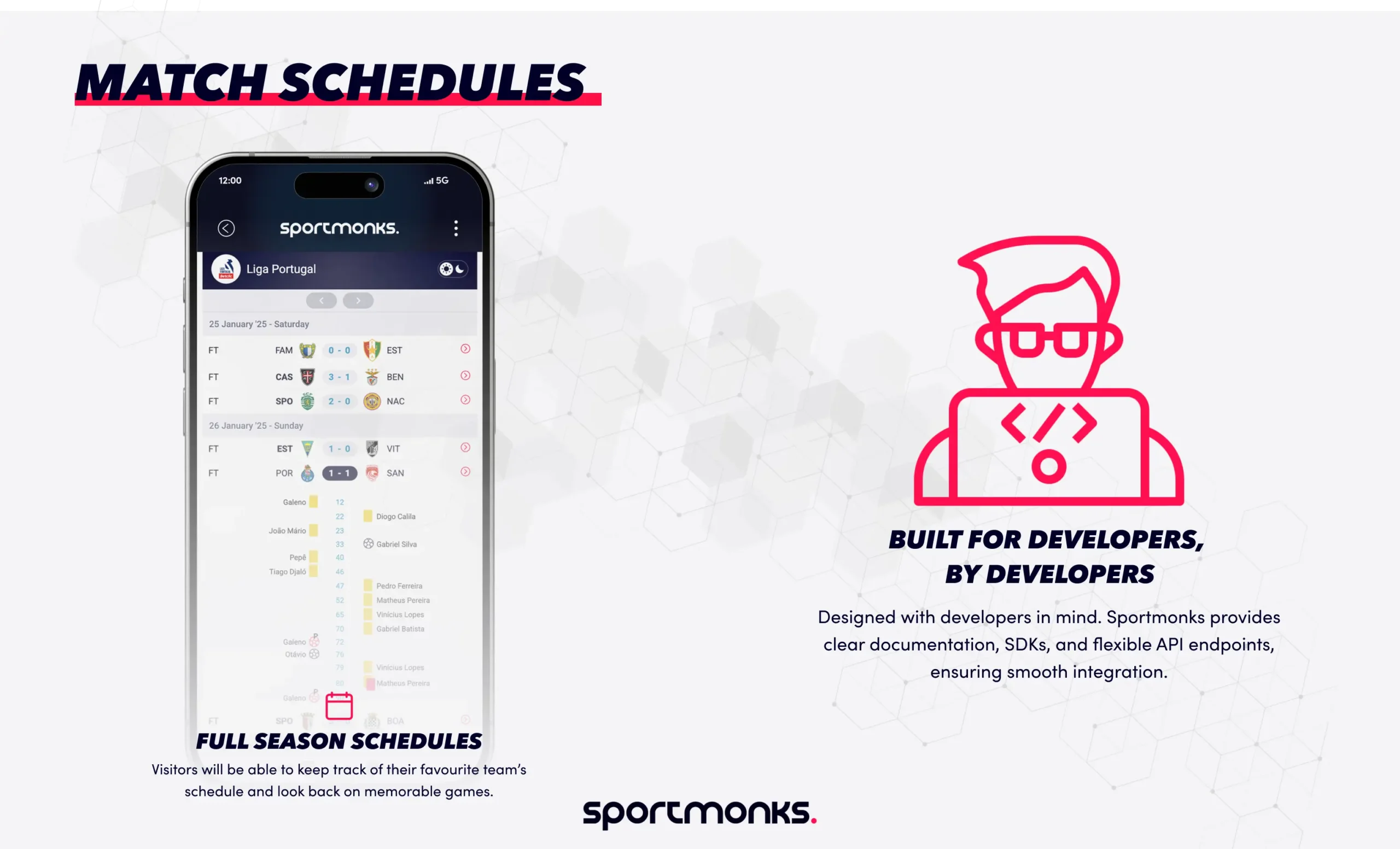
Sportmonks’ schedule endpoints offer a comprehensive, pre-nested data structure across three levels: stages, rounds, and fixtures. Each stage contains its rounds; each round contains its fixtures, including participant names, scores, result details, venue ID, and match state. This organisation enables you to display an entire season schedule without making repeated requests or merging multiple endpoint outputs.
Each fixture within the schedule response includes:
– Fixture ID, name, and starting datetime
– Home and away participants with team IDs, names, and image paths
– Match state (finished, live, upcoming) via state_id
– Full-time and half-time scores
– Result summary string (e.g. “Hearts won after full-time.”)
– Venue ID, leg, and match length
Each stage and round object contains is_current, finished, starting_at, ending_at, and games_in_current_week flags, equipping you to highlight the active stage or round instantly, without extra filtering.
Endpoints
There are three schedule endpoints, each suited to a different use case:
GET Schedules by Season ID returns the full schedule for a specific season, organised by stage and round. Use this endpoint to create a complete league fixture list or a season overview page.
GET https://api.sportmonks.com/v3/football/schedules/seasons/{season_id}?api_token=YOUR_TOKEN
GET Schedules by Team ID returns all schedules for a selected team across all seasons included in your subscription. Use this endpoint to develop a team history page or multi-season fixture archive.
GET https://api.sportmonks.com/v3/football/schedules/teams/{team_id}?api_token=YOUR_TOKEN
GET Schedules by Season ID and Team ID returns the schedule for a single team within a single season, structured by stage and round. Use this endpoint for a team’s season page, a matchday countdown, or a fixture list widget.
GET https://api.sportmonks.com/v3/football/schedules/seasons/{season_id}/teams/{team_id}?api_token=YOUR_TOKEN
Response structure
Unlike most endpoints in Football API v3, schedule endpoints do not support includes or filters. The response is pre-assembled and delivers stages, rounds, and fixtures together in a single nested format. This design makes it one of the most efficient endpoints for full-season rendering, as no additional requests are needed to compile data.
If you want more fixture details than the schedule response provides (such as lineups, events, or advanced stats), use the fixture ID from the schedule response to request specific data from the fixtures endpoint with your required includes.
What you can build with schedule data
– League fixture lists — a full matchday-by-matchday view of every fixture in a season, with scores and results for completed rounds
– Team season pages — a single team’s complete fixture list for the current or any historical season, with results and upcoming matches
– Matchday countdown widgets — use is_current and games_in_current_week to surface only the active round’s fixtures.
– Fixture calendars — map fixtures by date across a season for a visual calendar or agenda view
– Historical archives — retrieve multiple completed seasons for a team or league using the by-team or by-season endpoints
– Match notification systems — pull the schedule once at season start and use the starting_at timestamps to schedule alerts or reminders.
Availability
Schedule data is included in all Starter, Growth, Pro, and Enterprise plans. The available leagues depend on your plan and the leagues you choose. To get schedule data for seasons older than three years, use the historical data add-on. This has a one-time fee of €29 for Starter subscribers. Enterprise plans include full historical access by default.
You can explore the schedule endpoints in the Sportmonks Postman collection or test them directly using the API tester in MySportmonks.
Try it free — all paid plans include a 14-day free trial, and the forever-free plan gives you immediate access to the Danish Superliga and Scottish Premiership with no credit card required.
FAQs about schedule data