
Contents
What changed and why it matters
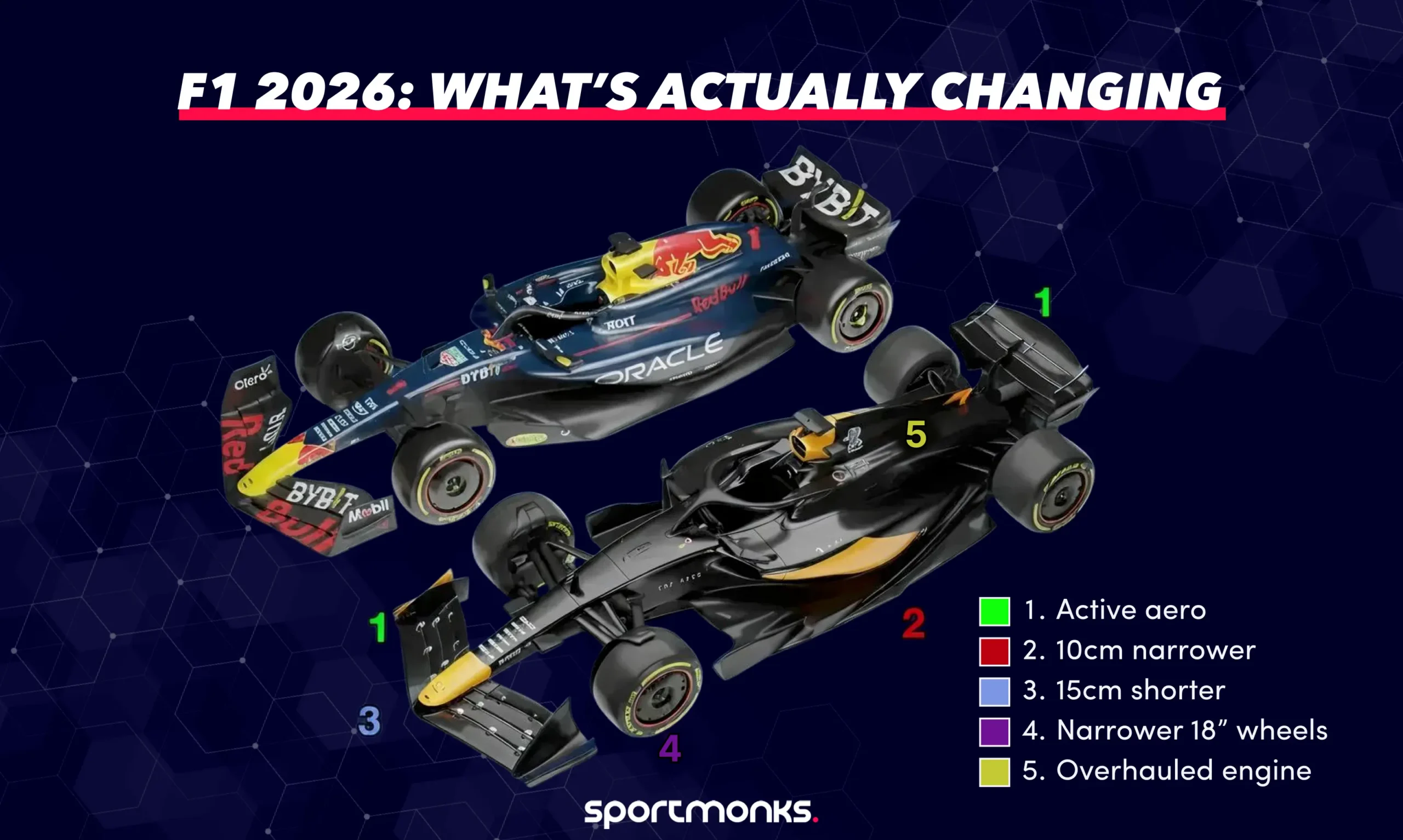
The 2026 regulations represent a reset across every major dimension of an F1 car. Chassis, power unit, aerodynamics and fuel have all been revised at the same time in a way that has not happened in the sport’s modern era.
The power unit: a 50/50 split
The 1.6-litre turbocharged V6 architecture introduced in 2014 remains, but everything around it has changed. The MGU-H, the heat recovery motor that used to sit on the turbo, is gone. In its place, the MGU-K’s output has increased significantly to about 350 kW, up from around 120 kW previously. This results in approximately 50 per cent from internal combustion and 50 per cent from electrical power, while still producing more than 1000 bhp overall.
Drivers now have to actively manage how and when electrical energy is recovered and deployed. Energy management has become a key tactical decision as drivers choose how to regenerate battery energy and use it throughout a lap.
Reliability and new architectures
All five power unit manufacturers are launching new power unit designs for 2026 with the rebalanced hybrid system and sustainable fuel requirements. Audi joins Formula One as a works engine maker, Honda returns as a supplier to Aston Martin and Red Bull, and Ford partners with Red Bull Powertrains. Ferrari and Mercedes continue their programmes, and Alpine switches to Mercedes power. Renault ends its era as an engine supplier.
Active aerodynamics and the end of DRS
The drag-reduction system used since 2011 has been removed and replaced with active aerodynamic systems on both the front and rear wings. These movable aero elements allow drivers to change downforce and drag settings as needed during a lap. A new Overtake Mode allows additional electrical power to be deployed when a car is within one second of the car ahead, supporting overtaking in place of the old mechanical flap system.
Car dimensions and weight
Car dimensions have been reduced. The wheelbase has gone from 3600 mm to 3400 mm, the width is now about 1900 mm, and the minimum weight is around 770 kg, roughly 30 kg less than before. The combination of smaller size and lower weight is intended to make the cars more agile through slow and medium corners.
The power unit landscape is reshuffled
In 2026, the manufacturer lineup looks very different:
– Red Bull Ford Powertrains runs its first self-built engine in partnership with Ford and is no longer using Honda power.
– Honda is the exclusive supplier to Aston Martin with its own new V6 hybrid unit.
– Audi completes its entry as a full factory power unit maker for 2026.
– Alpine switches from Renault to Mercedes power units.
– Cadillac enters as the eleventh team and initially uses Ferrari customer engines while its own power unit programme develops.
The competitive implications are significant because teams and power unit suppliers are all adapting to a radically new architecture and sustainable fuels, and there is no established performance hierarchy yet under the 2026 rules.
The pre-season controversy: compression ratio
A dispute emerged before testing over the new power unit regulations’ compression ratio limit of 16 to 1.
Mercedes was thought by some rival teams to achieve a higher effective ratio under hot running conditions while still meeting the cold measurement requirement. The FIA’s World Motor Sport Council has approved a rule revision that, from 1 June 2026, requires the compression ratio to be controlled at both cold and hot operating conditions, and, from 2027, the hot condition test alone will be the reference. All power unit manufacturers voted in favour of the change, and Mercedes has said it expects no performance difference as a result.
Albert Park: what the circuit demands
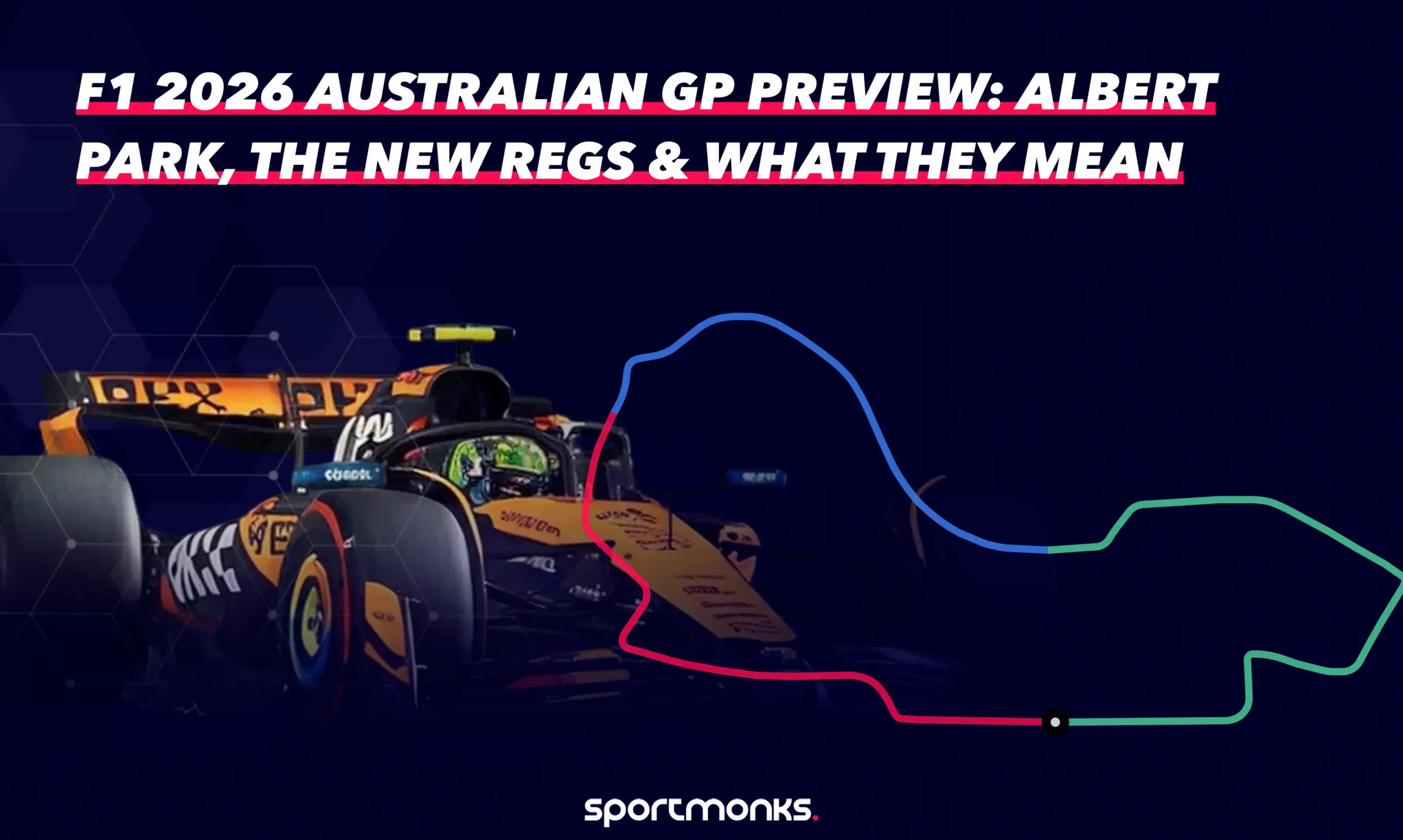
The Albert Park circuit is 5.278 km long with 14 corners and runs clockwise around Albert Park Lake in Melbourne’s inner south. It is a semi-permanent street circuit built each year on public roads and typically draws a large crowd during an Australian Grand Prix weekend, with total attendance often exceeding 400,000.
The surface at Albert Park starts the weekend relatively low on grip because the roads are used for normal traffic outside the Grand Prix. As sessions progress and rubber is laid down on the racing line, grip improves significantly, making data from early practice less predictive than at permanent circuits. Teams that accurately read the evolving surface often gain an edge.
In 2021, the layout was modified to improve flow and overtaking opportunities. The previous chicane at Turns 9 and 10 was removed, and several corners were widened, creating longer high-speed sections and a generally faster track.
The official race lap record at Albert Park is 1:19.813, set by Charles Leclerc in 2024.
Albert Park combines heavy braking zones with flowing medium-speed sections. The run into Turn 1 from the main straight is a key overtaking point early in the lap, while the sequence around Lakeside Drive features fast corners where mechanical grip and suspension performance stand out. The run from the final turn back to the start line is a sustained high-speed section where exit performance is crucial.
Under the 2026 technical regulations, DRS is no longer used, replaced by new overtaking systems such as Straight Mode and Overtake Mode that are being introduced at this event. Updated track maps reveal that Straight Mode zones will replace the old DRS zones at Albert Park for 2026, reflecting the shift in overtaking aids under the new rules.
Whether the new system produces comparable overtaking opportunities to the old DRS layout will become clearer once racing begins, with the Australian Grand Prix offering the first real test of how the new rules affect on-track passing.
The stories to watch
Lando Norris, defending champion. He arrives at Melbourne carrying the number one on his McLaren as the reigning Drivers’ Champion, a first in his career as champion. Norris beat Max Verstappen and Oscar Piastri to the 2025 title and will aim to defend it under the new regulations. Ferrari posted the fastest lap in one session of the Bahrain pre-season tests, with Charles Leclerc topping a day of running, making the gap between McLaren and Ferrari an early benchmark.
Max Verstappen and the new Red Bull era. The four-time world champion heads into 2026 with Red Bull Racing’s first in-house power unit developed with Ford and no longer powered by Honda. Verstappen continues as a major title threat, and his teammate for 2026 is Isack Hadjar, promoted from Racing Bulls, where he debuted in 2025.
Aston Martin and Honda. Aston Martin returns with a new Honda power unit partnership that faced significant reliability and performance issues during pre-season testing, limiting mileage and progress. Reports describe battery and engine challenges that Aston Martin and Honda must address before the first race. Fernando Alonso and Lance Stroll will drive for the team.
Audi and Cadillac. Both make their Formula 1 debuts in 2026. Audi takes over the Sauber entry as a works team with its own power unit, and Cadillac joins the grid as a new American constructor. Early expectations are that neither team will challenge for top points immediately, and simple race finishes would be useful early benchmarks of progress.
Tracking the race with the Sportmonks Motorsport API
The Sportmonks Motorsport API v3 covers every session of the 2026 season, including qualifying, practice, and race data from Melbourne. The API is currently in beta and uses the base URL https://api.sportmonks.com/v3/motorsport/. All requests require an API token.
Get the Australian GP fixture
Start by pulling the race fixture. The venue and participants include gives you the circuit details and the full driver/team entry list alongside the session metadata:
const fetch = require('node-fetch');

const API_TOKEN = 'YOUR_API_TOKEN';
const BASE_URL = 'https://api.sportmonks.com/v3/motorsport';

async function getAustralianGP() {
 const url = [
   `${BASE_URL}/fixtures`,
   `?api_token=${API_TOKEN}`,
   `&include=venue,participants,stage,season`,
   `&filters=fixtureName:Australian Grand Prix`
 ].join('');

 const res = await fetch(url);
 const { data } = await res.json();

 return data.map(fixture => ({
   id: fixture.id,
   name: fixture.name,
   venue: fixture.venue?.name,
   date: fixture.starting_at,
   state: fixture.state?.name,
 }));
}
Track qualifying and race results live
During the session, use the livescores endpoint to get real-time session state. The state include tells you whether the session is live, finished, or between stages:
async function getLiveRaceState() {
 const url = [
   `${BASE_URL}/livescores`,
   `?api_token=${API_TOKEN}`,
   `&include=drivers,teams,venue,state`,
 ].join('');

 const res = await fetch(url);
 const { data } = await res.json();
 return data;
}
Pull lap-by-lap timing
Once you have the fixture ID, lap timing data is available for each fixture and driver. This is the data layer for race pace analysis. You can compare sector consistency, identify where Norris and Leclerc are gaining or losing time on each other, and track how the battery deployment strategy affects lap time through the race:
async function getLapTimes(fixtureId, driverId) {
 const url = driverId
   ? `${BASE_URL}/fixtures/${fixtureId}/laps/drivers/${driverId}?api_token=${API_TOKEN}`
   : `${BASE_URL}/fixtures/${fixtureId}/laps?api_token=${API_TOKEN}&include=driver,team`;

 const res = await fetch(url);
 const { data } = await res.json();
 return data;
}
Get pit stop data
Strategy will be a defining factor in Melbourne; the safety car history at Albert Park is long, and a well-timed stop under a virtual or real safety car can swing the result by multiple positions. Pit stop data is available per fixture:
async function getPitStops(fixtureId) {
 const url = [
   `${BASE_URL}/fixture/${fixtureId}/pitstops`,
   `?api_token=${API_TOKEN}`,
   `&include=driver,team`,
 ].join('');

 const res = await fetch(url);
 const { data } = await res.json();
 return data;
}
Championship standings after round one
Once the race concludes, pull the updated Drivers’ and Constructors’ standings. Melbourne will be the first data point in a season where the starting order is genuinely uncertain; whoever leads after lap one of the championship can legitimately claim to have something real:
async function getStandings(seasonId) {
 const url = [
   `${BASE_URL}/standings`,
   `?api_token=${API_TOKEN}`,
   `&include=driver,team`,
   `&filters=standingSeasons:${seasonId}`,
 ].join('');

 const res = await fetch(url);
 const { data } = await res.json();
 return data;
}
Note: The Motorsport API v3 is currently in beta. Endpoint behaviour and field names may receive incremental updates as the season progresses. Build with light defensive error handling and monitor the changelog regularly.
What Melbourne will tell us
Albert Park may not give a complete read on every type of circuit. Its semi-permanent layout mixes medium and high-speed sections with technical corners. Because the track is built annually on public roads, its surface starts relatively low on grip before rubber build-up improves conditions through the weekend. This evolution and the need to adapt the setup under changing grip levels make Melbourne a unique test rather than a definitive benchmark for other circuits.
Ferrari team principal Fred Vasseur has publicly said that performance in Melbourne will not necessarily define the competitive picture for the 2026 season, given the rapid development expected under the new regulations.
What the Australian Grand Prix will offer is the first real race-speed test of the 2026 overtaking systems now in place of DRS, along with how teams cope with evolving track conditions and new energy management demands. Early running at Albert Park will show how quickly drivers and engineers adapt to these changes, and where strengths and weaknesses begin to form.
The slippery surface on Friday, which typically improves across the weekend, will again highlight the importance of accurately reading track evolution and making setup decisions with incomplete weekend information.
With every team running extensively revised machinery for the first time, and with these new systems being used in competition for the first time, this is one of the most uncertain opening rounds in recent Formula 1 history. That uncertainty, depending on your perspective, is either the most interesting thing about the 2026 season or a source of concern. Either way, it will begin to resolve on Sunday, 8 March.
Track every session of the 2026 season with real-time F1 data
Follow the Australian Grand Prix and the full 2026 championship with the Sportmonks Motorsport API. Access fixtures, live session states, lap-by-lap timing, pit stops and updated standings through a structured REST API. Build race trackers, analytics dashboards or media products powered by reliable motorsport data.
FAQs